

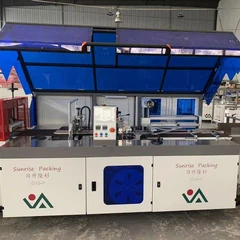
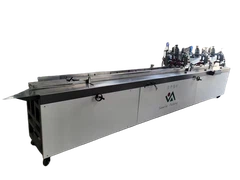
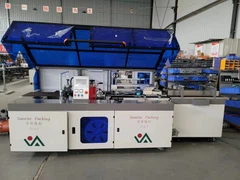
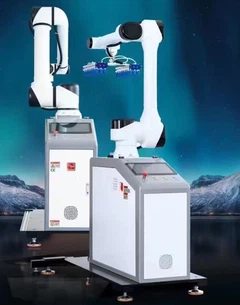


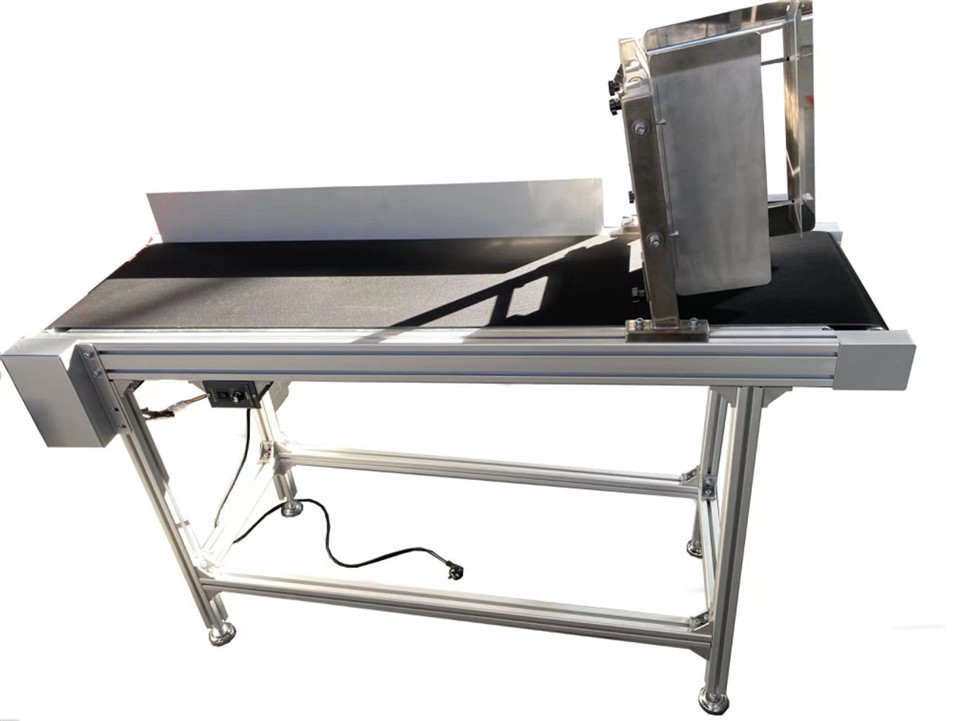
Rubber Belt Conveyor
Rich experience: Sunrise(Tianjin) packaging Machinery CO.,LTD, established in 2008 (Before name is Beijing Sunrise Packing Machinery Co.,LTD.)and has been committed to production and sales of post-packaging equipment and related material since established 17 years ago.
Diverse product types: Sunrise(Tianjin) packaging Machinery CO.,LTD is professional in researching and development of the following products: Plastic sealing machine, heat shrink packaging machine, baler, sealing and cutting machine, labeller, book distribute machine, Auto weighing machine, automatic unpacking machine, packing machine, belt conveyor, SS steel conveyor, stacker, automatic packaging line, shrink film and other related accessories.
Customized services: We can customized packaging equipment according to different goods and spaces of customers, make the product packaging automatically in production. Before production, we will provide technical guidance and help to debug the machine.
High quality: In many years of production practice has accumulated a wealth of on-site practical application experience, it lays the foundation of customer service.Excellent product quality and timely perfect after-sales service system are winning more and more praises of customers, and establish a long-term stable cooperative relationship with customers.
What Is a Rubber Belt Conveyor
Rubber belt conveyors are the most versatile and simplest material handling systems. They work with two or more pulleys driving an endless loop belt. The loop then moves a product from point a to point b on the belt. Belt conveyors are commonly used in both manufacturing and distribution facilities.

Unpower Conveyor is mainly composed of conveyor belts, brackets, rollers and guide devices. Conveyor belts are usually made of wear-resistant and corrosion-resistant materials that can withstand the weight and friction of the material. The bracket is used to support the conveyor belt to ensure its stable operation. The rollers are installed under the conveyor belt and roll to reduce the friction between the conveyor belt and the bracket so that the material can slide smoothly. The guide device is used to adjust the running direction of the conveyor belt to ensure that materials can be transported according to the predetermined path.

Belt Conveyor Manufacturers focuses on producing various types of belt conveyors. These equipment are widely used in various industries and scenarios to achieve efficient and continuous transportation of materials. Its product introduction usually covers the following aspects:

Rubber belt conveyors are widely used in material transportation in various industries. They consist of a belt made of rubber material that moves continuously around two or more rotating drums. The belt is supported by idlers and rollers, which contribute to efficient and smooth operation.
Packing Conveyors play an important role in many industries, especially those that require efficient, automated packaging processes. The following are the main application areas of Packing Conveyor:

Conveyor Belt Equipment (conveyor belt equipment) has significant product advantages in the field of material transportation, and these advantages make it widely used in multiple industries. Here are the key product benefits about Conveyor Belt Equipment:

Power Belt Conveyors are mechanical equipment that utilizes continuously running conveyor belts for material transportation. It is mainly composed of driving device, conveyor belt, roller, tensioning device, redirection device and frame. The driving device drives the conveyor belt to move, and the materials are placed on the conveyor belt and transported to the designated location as the conveyor belt moves.
Rubber belt conveyor is mainly composed of frame, conveyor belt, belt roller, tensioning device, transmission device, etc. It can form a material on a certain conveyor line from the initial feeding point to the final unloading point.
Rubber belt conveyor has the characteristics of heat resistance, high temperature resistance, burning resistance, acid and alkali resistance, cold resistance, wear resistance, oil resistance, flame retardant, tear resistance, puncture resistance and so on.
It is suitable for working environment temperature between low temperature -15 ℃ and high temperature 40 ℃, and material temperature does not exceed 50 ℃.
Rubber belt conveyor is used for continuous or intermittent operation of conveyor belt to transport various items of different weight and weight. Abrasion and oil resistance.
How Does Rubber Belt Conveyor Work
Conveyors are durable and reliable components used in automated distribution and warehousing, as well as manufacturing and production facilities. In combination with computer-controlled pallet handling equipment this allows for more efficient retail, wholesale, and manufacturing distribution. It is considered a labor-saving system that allows large volumes to move rapidly through a process, allowing companies to ship or receive higher volumes with smaller storage space and with labor expense.
Rubber belt conveyors are generally fairly similar in construction consisting of a metal frame with rollers at either end of a flat metal bed. Rubber conveyor belts are commonly used to convey items with irregular bottom surfaces, small items that would fall in between rollers (e.G. A sushi conveyor bar), or bags of product that would sag between rollers. The belt is looped around each of the rollers and when one of the rollers is powered (by an electrical motor) the belting slides across the solid metal frame bed, moving the product. In heavy use applications, the beds in which the belting is pulled over are replaced with rollers. The rollers allow weight to be conveyed as they reduce the amount of friction generated from the heavier loading on the belting.
Rubber belt conveyors can be used to transport products in a straight line or through changes in elevation or direction. For conveying bulk materials, over gentle slopes or gentle curvatures, a troughed rubber belt conveyor is used. The trough of the belt ensures that the flowable material is contained within the edges of the belt. The trough is achieved by keeping the idler rollers in an angle to the horizontal at the sides of the idler frame. A pipe conveyor is used for material travel paths that require sharper bends and inclines up to 35 degrees.
Other important components of the belt conveying system apart from the pulleys and idler rollers include the drive arrangement of reducer gear boxes, drive motors, and associated couplings. Scrapers to clean the belt, chutes for controlling the discharge direction, skirts for containing the discharge on the receiving belt, take up assembly for "tensioning" the belt, safety switches for personnel safety and technological structures like stringer, short post, drive frames, pulley frames make up the balance items to complete the belt conveying system. In certain applications, rubber belt conveyors can also be used for static accumulation or cartons.
The advantages of rubber belt conveyors include:
● It is a cheap way of moving materials over long distances.
● It doesn't degrade the product being conveyed.
● Loading can be done at any place along the belt.
● With trippers, the belts can offload at any point in the line.
● They do not produce as much noise as their alternatives.
● Products can be weighed at any point in the conveyor.
● They can have long operating times can even work for months without stopping.
● Can be designed to be mobile as well as stationary.
● Have less dangerous hazards to human injury.
● Low maintenance costs.

While there are numerous types of belt conveyors, all serve the same purpose of transporting materials. Some products may require a system without a belt, using only rollers or wheels for flexible movement. However, many belt conveyors rely on a frame with a belt and possible support rollers to carry materials and products efficiently.
All conveyor systems have three main components - the aluminum profile, the driving unit and the extremity unit.
In a rubber belt conveyor, the aluminum profile consists of the frame, belt and any supports. Systems that use a belt are generally powered by a motor, though conveyor systems can also use gravity or manual force to function. Motorized conveyor belts are ideal for industrial use as they are more reliable and efficient - the driving unit for such systems would include the motor bracket, electrical drive and any counter bearings.
The rubber belt conveyor's extremity unit typically includes any pulleys and clamping straps. Additional stands or lateral guides could be necessary for specific variations or functions, so consider your industry's needs when choosing these optional add-ons. Parts and functions of a new rubber belt conveyor might include:
● The frame: The system's framework holds all of the moving parts together for safe and secure operation.
● The belt: A long stretch of thick, durable material upon which materials are transported from one place to another.
● The conveyor belt support: Rollers assist the belt to stay on course and swiftly maintain movement. Rollers keep objects in place and prevent the belt from sagging.
● The driving unit: Motors may use either variable or constant speed-reduction gears to power the conveyor belt. An efficient driving unit must continually assist the belt with continuous running, smooth reversing and repeatedly adjusting direction.
● The pulleys: The conveyor belt should loop over two or more strategically positioned pulleys. The pulley controls the belt's movement and performs critical functions such as driving, redirecting, turning, tensioning and tracking the belt.
● The clamping straps: Clamping straps are used on various machines to hold down fixtures and work components.
● Add-on modules: Most additional parts are installed for further reinforcement. While rollers support the belt from within the system, stands and lateral guides support the outer framework.
Rubber Belt Conveyor Specification
The specification of the rubber belt conveyor is normally dependent on the application, industry, and product type. Manufacturers of bespoke and custom rubber belt conveyor systems will ask about what the end usage of the conveyor will be, this is to ensure the conveyor system is built to suit that application. Things you should consider include the maximum load capacity, the conveyor belt system speed, throughput, the frame material or shape, and also drive configuration.
As well as this the type of product or material to be conveyed must be considered. Conveyor belts for the food industry for example must be suitable for washdowns and disinfecting. These conveyors often have a blue belt material, to denote they are washdown suitable which is a requirement of food hygiene laws. The belt surface itself also needs to be resistant to scratches or damage, as that could harbour bacteria.
Another consideration for your rubber belt conveyor supplier is static electricity, as conveyor belts can generate static as they travel around the pulleys. Where static sensitive components need to be conveyed, this could be harmful to the product. A conveyor belt manufactured with anti-static technology, for example conductive belting, or static control brushes solves this problem.
Some items may be sensitive to vibration, pressure, or could be hazardous materials. These should therefore be discussed with the conveyor manufacturer so they can counter risks, thus ensuring the conveyor designed is fit for purpose.
The environment the conveyor will be running in is also important as humidity or temperature can affect operation. Consequently the conveyor needs to meet certain specifications to be able to continue optimal performance.
How to Choose the Right Rubber Belt Conveyor
Before deciding on what type of conveyor system is right for your application, there are three major factors to consider:
Material
This is the most crucial consideration when choosing a conveyor belt system. Think about the size, moisture content and whether the material you are moving flows or is abrasive/corrosive. Another consideration is whether the material needs to maintain a specific temperature. What is the composition of your material? Is it a powder or granule, pellet or fiber? Particle weight, density and size are also things you will need to take into account.
Function
Is this a conveying or feeding process? Conveying is transporting materials from a pick-up point to a drop-off point. If so, you'll need to know the number of points, the amount of material, the amount of time it should take and whether there will be a problem if cross-contamination occurs. Feeding is the more straightforward of these conveyor systems, requiring a straight pick-up to drop-off point. The product may need to be delivered in batches or at a controlled rate.
Environment
Where is the facility located? Will you encounter high temperatures/humidity, pressure or vibrations? Are you working with fragile materials? If you use flammable or hazardous materials, potential risks and workarounds need to be assessed. The rubber belt conveyor's size in relation to the workspace and other equipment is another consideration.
The Different Types of Rubber Belt Conveyors
There are many different types of rubber belt conveyors.
Powered rubber belt conveyors are the most common type of rubber belt conveyor. They are powered by a motor, which drives a belt that transports the objects from one place to another. Powered conveyors are often used in factories, warehouses, and other industrial or commercial settings to move materials from one area to another.
Roller rubber belt conveyors use rollers instead of belts to transport objects from one place to another. Roller rubber belt conveyors are often used in packaging and assembly lines.
Incline conveyors are a type of powered roller conveyor. They use an incline to move the objects from one place to another. Incline rubber belt conveyors are often used in shipping and logistics applications. These are needed when moving from the floor to a higher level within the facility.
Cleated rubber belt conveyors use cleats, or ridges, on the belt to help grip and move the objects being transported. Cleated conveyors are often used in manufacturing and shipping applications. They are ideal for conveying wet, sticky, or dirty materials.
Slider bed rubber belt conveyors use a slider bed or (flat bottom that a belt slides across) to move the objects being transported. Slider bed rubber belt conveyors are often used in food processing and packaging applications. They also work well for conveying items in wet and sticky environments.
Mainly a rubber belt conveyor is helpful to move safely both regular or irregular-shaped, large or small size, light or heavy weight objects, from one location to another.
A rubber belt conveyor can be installed in industries like aerospace, food, manufacturing, pharmaceuticals, etc at a very economical cost.
A rubber belt conveyor can be successfully used to load or unload passenger's luggage. While in the manufacturing sector, bulky materials are being transported efficiently within the plant area, without human error.
Each rubber belt conveyor system has its own applications and advantages, depending upon the type of industry it has to be implemented.

Our Factory
Sunrise(Tianjin) packaging Machinery CO.,LTD, established in 2008 (Before name is Beijing Sunrise Packing Machinery Co.,LTD.)and has been committed to production and sales of post-packaging equipment and related material since established 17 years ago.Excellent product quality and timely perfect after-sales service system are winning more and more praises of customers, and establish a long-term stable cooperative relationship with customers.

video
Company Certificate
High-tech Enterprise Certificate,utility Model Patent Certificate*3,Computer Software Copyright Registration Certificate*4

FAQ
Hot Tags: rubber belt conveyor, China rubber belt conveyor manufacturers, suppliers, factory, conveyor with conveyor tunnel, conveyor with conveyor magnetic sterilized, conveyor system, conveyor with conveyor guide, conveyor for solid materials, conveyor with conveyor body
You Might Also Like


Send Inquiry